
Stop Translating in Your Head: How Native Speakers Break the Translation Trap
When you are learning a foreign language, you hear the same piece of advice from teachers and apps constantly: "Stop translating in your head and just speak!"
It sounds like solid guidance. It is also incredibly frustrating.
It is completely natural to translate everything back into your native language when you are starting out. Textbooks literally prime our brains to do this by providing vocabulary lists and example sentences with direct translations side-by-side. Our minds naturally reach for what is familiar to make sense of the unfamiliar. There is absolutely nothing wrong with that initial instinct.
So, how are we actually supposed to understand the advice to "stop translating"?
What teachers really mean is that we should try to use the limited words we already know to express ourselves, rather than trying to build complex, word-for-word replicas of our native thoughts. But as anyone who has tried it knows, breaking out of that mental loop is easier said than done — and if you are also fighting the fear of how you sound when you open your mouth, that is a whole other layer of the problem.
Why you can't stop translating in your head (it's not your fault)
Here is why your brain gets trapped, and how a native speaker is the ultimate key to breaking free.
1. The lesson that changed everything
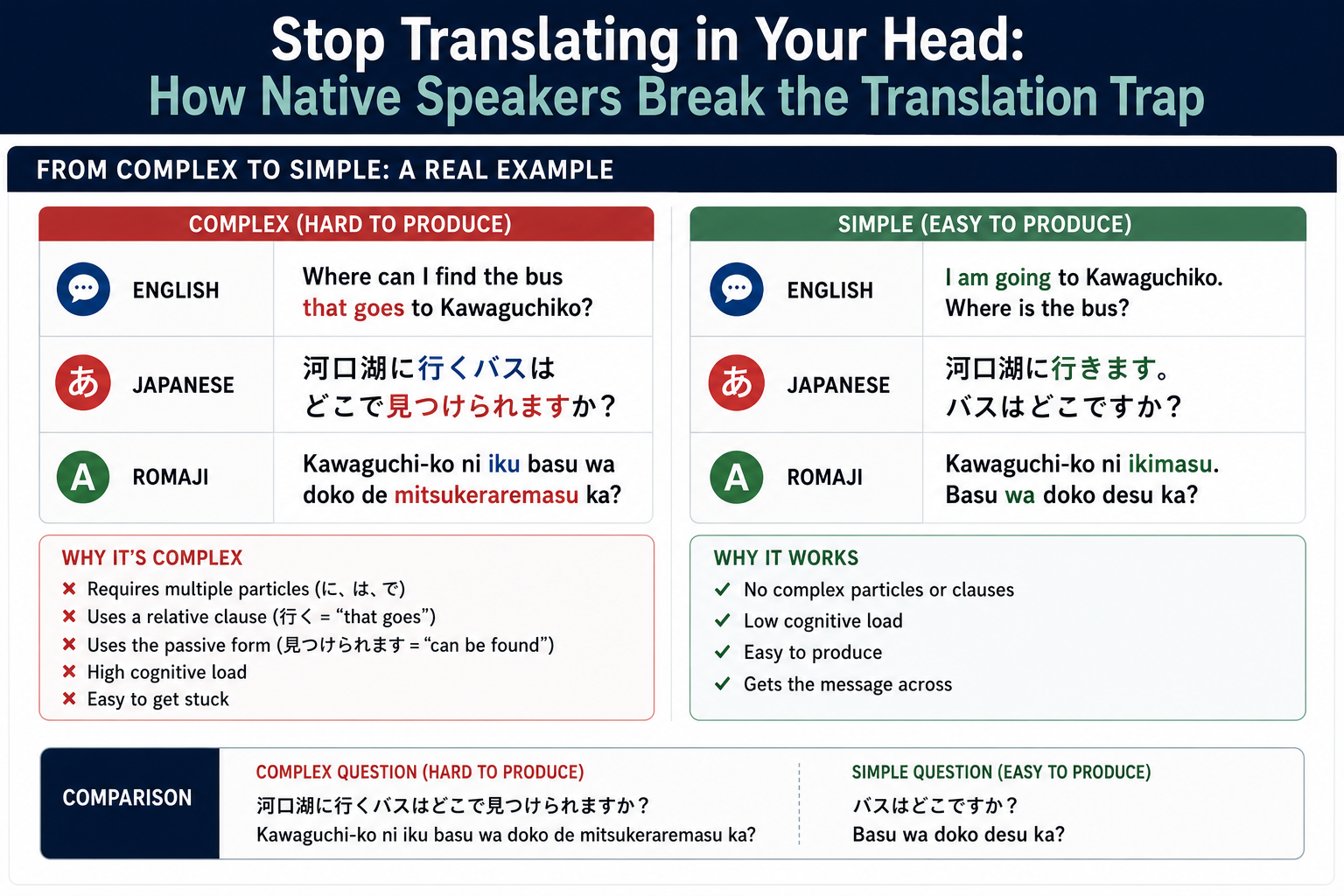
Last year, while taking Japanese classes before a trip, I told my teacher about a logistical worry: upon arriving at the station, I would have exactly ten minutes to find my connecting bus.
We decided to practice the scenario. I sat there trying to construct the exact question I would ask in real life:
"Where can I find the bus that goes to Kawaguchiko?"
Because I hadn't yet mastered the complex particles needed for that clause, I got stuck trying to translate my adult German thoughts word-for-word. Seeing me lose the forest for the trees, my teacher stepped in with a brilliant simplification:
"Just say: 'I am going to Kawaguchiko. Where is the bus?'"
Two short, blunt sentences. It was a total epiphany. As a professional German teacher myself, finding language simplifications for students is literally my job. Yet, when the tables were turned, I was completely blind to it.
2. The science of simplification and the overloaded brain
In the field of Second Language Acquisition (SLA), what my teacher pushed me to do is a recognized communication strategy — specifically, a combination of approximation and circumlocution. It means intentionally managing your language to prioritize meaning over absolute grammatical complexity. It is a cornerstone of building communicative competence: the ability to successfully get your point across in real-world scenarios, even if your grammar isn't perfect yet.
So why couldn't I do this myself? The answer lies in how our brains process speech under pressure, which boils down to three major research-backed concepts:
Formulaic Language: In native speech, your brain doesn't build sentences from scratch. According to linguistic studies on vocabulary acquisition, we rely heavily on pre-packaged phrases and collocations called formulaic language. We just pull these ready-made blocks off the shelf without thinking.
Cognitive Load: When you switch to a foreign language, that automatic library disappears. As outlined in John Sweller's Cognitive Load Theory, your working memory becomes heavily overloaded because you have to consciously manage vocabulary retrieval, syntax, morphology, and pronunciation all at once. This leaves zero mental bandwidth for creative phrasing.
Retrieval Block and the "Monitor Effect": Linguist Stephen Krashen defined the Monitor Hypothesis, which explains that when we are over-focused on grammar rules, we create an internal bottleneck. This cognitive overload triggers a literal retrieval block. Your brain simply lacks the free processing space to zoom out, look at a thought creatively, and find a clever workaround — a barrier well-documented in research on strategic competence and communication strategies.
Trapped in this tunnel vision, your brain defaults to the only fully operational system it has left: the exact, complex structure of your first language. This forces you right back into the trap of word-for-word translation. It is the same underlying mechanism that keeps heritage speakers — people who grew up hearing a language at home — from being able to speak it freely. The language is in there. The pathway to pull it out is blocked.
3. Native speakers see the exit you are missing
This is exactly why self-study apps and solo grammar drills cannot teach you to stop translating. To break the cycle, you need an outside perspective to hand you the shortcut.
During my lesson, I could not see the simple route because I was trapped inside my own cognitive load. My teacher, looking from the outside with the clear, unburdened viewpoint of a native speaker, could instantly strip away the grammatical clutter.
Because a native speaker isn't wrestling with grammar or vocabulary retrieval, they possess the intuitive linguistic flexibility to quickly simplify a thought. They can see the direct path. They reshape the complex thought into a clean, basic alternative in real time — something a learner's overloaded brain simply cannot produce alone.
Breaking the translation trap with FluenTea
If you find yourself trapped in that translation loop, you do not need to study harder. You just need the right viewpoint to lift the fog.
This is where FluenTea changes the game. Our platform matches you with native speakers who are genuinely there to learn and practice. When you experience that inevitable tunnel vision, your tandem partner provides that unburdened native viewpoint, naturally offering the exact simplifications you need to keep moving forward.
And because those quick breakthroughs are easy to forget in the heat of a conversation, our AI coach, ChaCha, works quietly in the background. ChaCha provides live transcriptions and summaries of your exchange, capturing those golden, simplified phrases your partner used so you can review them and build your own functional fluency. After each session, ChaCha gives you a full breakdown of how you did: which phrases you nailed, where you got stuck, and what to practice next. So those "Kawaguchiko moments" don't just happen once and disappear.
Frequently Asked Questions
Why can't I stop translating in my head when speaking a foreign language?
Translation is a natural survival mechanism for beginner learners. But under the pressure of real conversation, your working memory becomes overloaded — you're managing vocabulary retrieval, syntax, and pronunciation all at once. According to John Sweller's Cognitive Load Theory, this leaves zero mental bandwidth for creative phrasing. Your brain defaults to the only fully operational system it has left: your first language. Breaking the habit requires an outside perspective — like a native speaker — to hand you the simplification your overloaded brain cannot produce alone.
What is the Monitor Hypothesis in language learning?
Linguist Stephen Krashen's Monitor Hypothesis explains that when learners are over-focused on grammar rules, they create an internal bottleneck. Instead of speaking naturally, you "monitor" every word for correctness, which slows you down and blocks simpler, more creative phrasing. This is why knowing grammar isn't enough — you need real conversation practice where your brain learns to trust what it knows.
How does a native speaker help you stop translating?
A native speaker isn't wrestling with grammar or vocabulary retrieval — they possess intuitive linguistic flexibility. They can look at your complex, word-for-word thought and instantly reshape it into a clean, simple alternative. This is something an overloaded learner's brain simply cannot do alone. It's why self-study apps and solo drills can't teach you to stop translating — you need an outside perspective.
What is circumlocution in language learning?
Circumlocution is a communication strategy where you describe a concept using simpler words you already know, rather than searching for the exact vocabulary. It's what Silke's Japanese teacher modeled when she said "I am going to Kawaguchiko. Where is the bus?" instead of the complex sentence Silke was trying to construct. It's a cornerstone of communicative competence — getting your point across even when your grammar isn't perfect.
Ready to stop translating and start talking?
You cannot think your way out of a translation trap all by yourself. Our brains simply are not wired that way. You need a real partner to show you the scenic, simple routes.
Join FluenTea today to get matched with a screened language partner. Let a native speaker help you clear the clutter so you can finally start speaking freely.