
Stop Translating in Your Head: How a Language Partner Can Help You Break the Translation Trap
Why “just stop translating” is hard advice to follow, and how my Japanese teacher’s simple rewording showed me a way out.
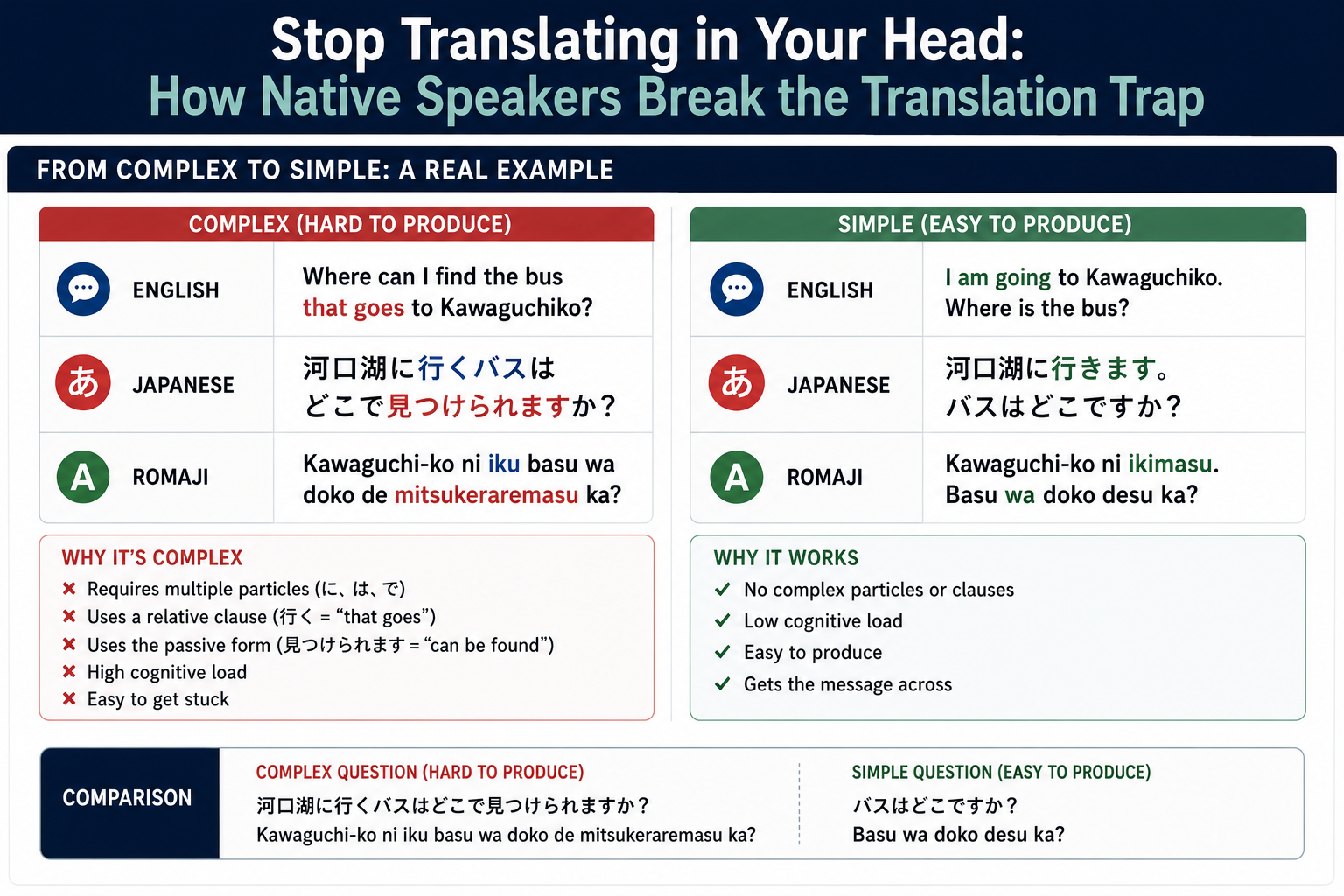
When you are learning a foreign language, you may often hear the same piece of advice: “Stop translating in your head and just speak!”
It sounds like good advice, but it can be hard to know what to do with it.
When you are starting out, it is natural to translate everything back into your first language. Many textbooks list vocabulary and example sentences with translations side by side, so translating is what we practice. There is nothing wrong with that instinct.
As I understand it, the advice means this: use the words you already know to say what you mean, instead of building a word-for-word copy of the sentence in your head. That is easier said than done, especially if you are also worried about how you sound.
Why it is hard to stop translating
1. My lesson about a bus to Kawaguchiko
Last year, while taking Japanese classes before a trip, I told my teacher about a logistical worry: when I arrived at the station, I would have exactly ten minutes to find my connecting bus.
We decided to practice the scenario. I sat there trying to construct the exact question I would ask in real life:
“Where can I find the bus that goes to Kawaguchiko?”
I hadn’t yet learned the particles I needed for that clause, so I got stuck trying to translate my German thoughts word for word. My teacher saw that I was stuck and suggested something simpler:
“Just say: ‘I am going to Kawaguchiko. Where is the bus?’”
Two short sentences. I teach German, and finding simpler ways to say things is part of my work with students. But when I was the learner, I couldn’t see the simple version myself.
2. Why I couldn’t see it
Looking back, I was trying to do too much at the same time. I was searching for words, putting them in the right order and thinking about particles I hadn’t learned yet. There was no room left to step back and ask what I really needed to say. My teacher’s version kept the meaning and dropped everything else.
Linguists call moves like this communication strategies. In a study of 90 Japanese university students learning English, Ivan Brown describes them broadly as attempts to solve communication problems and keep a conversation going. One of the strategies he looked at was paraphrasing: saying something in other words when the words you want aren’t there. Over about nine weeks, the classes practiced conversation, and some of them also worked with model dialogs that showed these strategies or learned words for using them. The students’ paraphrases improved in a speaking test at the end. Brown worked with existing classes and a single rater, and he calls his results tentative.
My teacher’s suggestion was closer to simplifying than to paraphrasing, but the idea is similar: find another way to say what you need with the words you have. Brown’s study suggests that this is something learners can practice.
3. Why it helps to have someone else in the conversation
In my lesson, it took someone else to show me the shortcut.
I was so busy with the sentence in my head that I couldn’t see the simple route. My teacher is Japanese, so Japanese is her first language, and she wasn’t caught up in my sentence. She could see the simple version right away.
Someone who speaks the language well, and who isn’t busy building your sentence, can often find a simpler way to say it. A language partner can do this too, when you ask them how they would say something.
Breaking the translation trap with FluenTea
If you find yourself in that translation loop, it can help to talk with someone who can show you a simpler way to say it.
FluenTea matches you with language partners who speak the language you are learning and are learning a language themselves. When you get stuck, you can ask your partner how they would say it.
Those simpler phrases are easy to forget in the middle of a conversation. ChaCha, our AI coach, works in the background and provides live transcriptions and summaries of your exchange, so you can go back to the phrases your partner used. After each session, ChaCha also shows you where you got stuck and what to practice next. That way, a Kawaguchiko moment doesn’t have to happen only once.
Back to the bus
When I think of that lesson, I remember how simple the answer was once someone showed it to me: “I am going to Kawaguchiko. Where is the bus?” If you get stuck in a translation loop, a partner can help you find your own short version.
Join FluenTea to get matched with a screened language partner.
Frequently Asked Questions
Why can’t I stop translating in my head when speaking a foreign language?
Translating is a natural starting point for beginners. In a real conversation, you have a lot to manage at once, from finding words to building the sentence, and that leaves little room to look for a simpler way to say something. A partner who isn’t caught up in your sentence can help you find one.
Is it bad to translate in my head?
No. When you are starting out, translating into your first language is natural, and many textbooks are built around it. It can help to practice saying things with the words you already know, even if the result is shorter than what you had in mind.
What is the Monitor Hypothesis in language learning?
In his book Principles and Practice in Second Language Acquisition, linguist Stephen Krashen proposed that the grammar rules we learn consciously have one main job: they work as an editor, or “monitor,” that can check what we say. He named three conditions for using it: time, a focus on form and knowing the rule.
How can a language partner help you stop translating?
Someone who isn’t busy building your sentence can often see a simpler way to say it. If you are stuck, you can ask your partner how they would say it, the way my teacher showed me in the Kawaguchiko lesson.
Comments