The Key You Already Carry: Why a Familiar Street Can Unlock a New Alphabet
A familiar street name can make a new alphabet readable fast. My story, what research suggests and ways to try it.
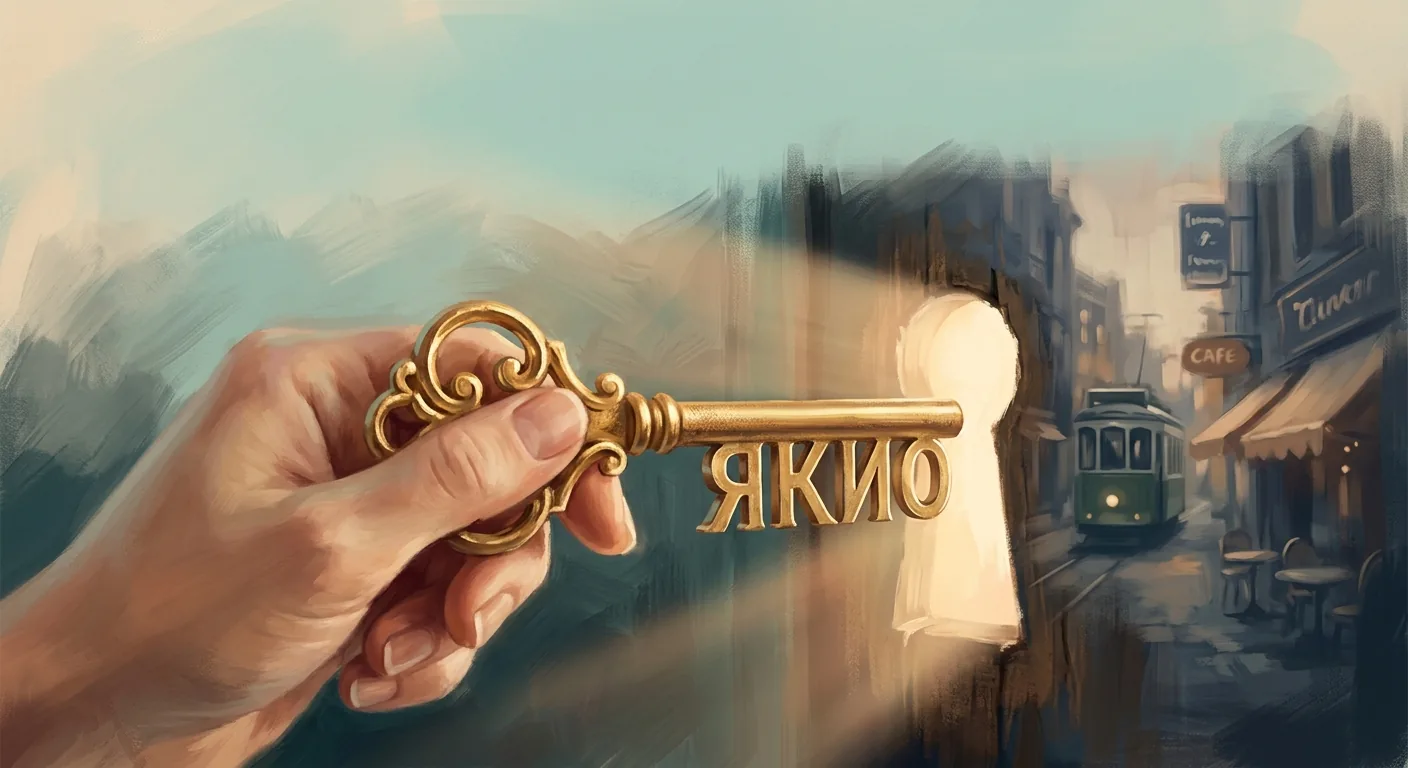
The first time I saw Cyrillic letters in my university class, my teacher told us we would leave the lesson able to read it. I was very sceptical.
Then she introduced the method used by our department of Slavic studies. Instead of a vocabulary chart, we were handed cards with popular street names and other common words written in Cyrillic. I looked at one of them: Якоминиплац. For a moment it was only a row of unfamiliar shapes. Then it clicked. Jakominiplatz, the central transit hub of the city, where its streetcar lines meet. A place I moved through every day. That small card was a key, and it opened a door that had looked closed a moment earlier.
A word you already know can be the key to a new alphabet.
It felt very rewarding. We saw results immediately, and we picked up the alphabet much faster than I had expected. Our teacher kept bringing examples like this, including a joke sentence from Germany that she showed us, written in Cyrillic:
Венн ду еин доофер Весси бист, каннст ду дас нихт лесен.
Sound it out and it is German: Wenn du ein doofer Wessi bist, kannst du das nicht lesen. In English: “If you are a daft Wessi, you cannot read this.” (“Wessi” is an informal word for someone from what was then West Germany.) It is a good example of Ostalgie, a blend of Osten (East) and Nostalgie (nostalgia), which describes the longing some people who grew up in East Germany feel for certain ways of life there, sometimes together with the wish that their experiences were better understood. It also makes a point that matters for anyone learning a new alphabet: you can read a sentence in it long before you can speak the language.
We were all aware that we had not mastered the Russian alphabet yet, and that it would take time to get really used to writing it. I kept coming back to the first part: why did a street name make an alphabet readable so fast?
Why it works: you already own everything except the code
Look again at the Ostalgie sentence. Every word is German, so you already know its sounds, its meaning and its grammar. The only new thing is the code that links letters to sounds. Jakominiplatz worked the same way: I knew the place, its name and what it meant in my daily life, so the letters only had to be matched to something that was already there.
It was not only the letters that clicked. Because I knew the word, I could take it in almost at a glance, a little like reading in my first language, where I do not read letter after letter either, but see the whole word. It was not exactly like that with Jakominiplatz in Cyrillic, but it felt similar.
The nineteenth century thinker Wilhelm von Humboldt wrote that language must make infinite use of finite means (in his German: von endlichen Mitteln einen unendlichen Gebrauch). In my own words: a limited set of letters and sounds can be combined into endless sentences. Russian has 33 letters. Once a few of them are yours, you can recombine them to read words you have never seen.
Paulo Freire built his literacy work on a similar idea. In 1963, he and a University of Recife team ran a 40-hour project to teach about 300 agricultural workers in Angicos, Brazil, to read and write. His method starts from generative words: words that matter in people’s lives and lead learners on to new words. I will look at his work more closely in my next post, You’re Not Starting From Zero: What Paulo Freire Knew About Language Learning [LINK TO POST].
Why words that are about you stick
Jakominiplatz was more than a name on a card to me. It was part of my daily life, and psychologists have a name for the memory boost that comes from linking new information to ourselves: the self-reference effect.
At the University of Haifa, Pruss, Karni and Prior (2025) tested this with 40 young Hebrew speakers who had basic conversational English. Each person learned 20 rare English words. Some words were used in a spoken sentence about the learner, others in a sentence explaining their meaning. People remembered about 29 percent of the self-referring words right away, against 23 percent of the others, and the advantage was still there a week later.
This was a small laboratory study with rare words and a spoken task, so I would call it a real boost, not a complete method. Writing is still untested.
Why whole words may be a good way in
My teacher started with whole words, not with a chart of letters. I wondered how the two ways of starting compare. A master’s thesis at the University of Colorado, Kiskin (2018), tested both. 34 English-speaking adults with no Russian learned Cyrillic over two days, starting either with 16 whole words or with 19 single letters. Neither approach won across the board: each had a small edge on a different test, and on most measures there was no difference. So starting with whole words held up well. The words carried no meaning for the participants. If a familiar place adds something on top, as my own experience suggests, this study could not show it.
What we do not know yet
As far as I could find, nobody has tested street names and alphabets directly. In a UK classroom project, children aged 9 to 11 learned Japanese kanji by drawing them in different ways, and memory did not differ between the conditions. A short video on self-referencing helped only the children who had drawn themselves without a memory cue. The project record is a data description rather than a peer-reviewed paper, so I would not build too much on it yet.
My own story carries a similar reminder. Reading came fast, but by my fourth year of Russian I could analyse grammar cases on a whiteboard while my conversation still felt clumsy, as I described in Why You Don’t Need ‘Talent’ to Speak a New Language. The first step is quick, and the rest takes time and practice.
Try it yourself
For learners
1. If your language has a new alphabet, make your own street cards. This is what my teacher’s cards did. Write down five to ten names you already know well: your street, your station, your city, a shop, a café. Find them written in the new alphabet, or in a syllabary such as Japanese kana (set your map app to that language, or ask a language partner). Read each one aloud before you check the answer, and notice which letters you now recognise.
2. In any language, say a true sentence about you with every new word. This is what the learners in the Pruss experiments did, with rare English words in a laboratory. If you have just learned the word for “bakery”, you could say where you buy your bread, in the language you are learning.
For language partners
Our teacher chose cards from a city we all knew. As a language partner, you can offer something similar: write the name of a street, a café or a station from your daily life in your language, let your partner read it aloud, tell them what the place means to you, and swap. You are sharing your world, which is the spirit of tandem learning, as I wrote in Tandem Language Learning: Why the Journey Is Better Together.
Back to Jakominiplatz
I still think of that card. It was only a first step, but a place I crossed every day was a key I already had, and it opened the first door. You have keys like this too: the street you live on, the café you love, the station you pass every morning. Which one will you try first?
Frequently asked questions
Why does a familiar word make a new alphabet easier to read?
Because you already know the word’s sound and meaning, so the only new thing is how the letters write it down. That is why the joke sentence was readable for us as beginners: we already knew every word of it.
Can I really learn a new alphabet in one lesson?
You can learn to sound out familiar words quickly, as I did. Writing, and reading at speed, take longer. Begin with names you already know: your street, your city, a shop you visit.
Does this only work for languages with a new alphabet?
The street cards work best with an alphabet or a syllabary, where symbols stand for sounds, and less well with systems such as Chinese characters, where symbols mostly stand for whole words or meanings. The second practice works in any language: say a true sentence about your life with each new word. It comes from an experiment with rare English words, so it is my adaptation of the idea.
My language partner lives in another country. Do we need shared places for this to work?
No. Most language partners live in different places. Each of you knows your own world best, so you can show it: describe the view from your window, share a photo of your street, or look at a map together.
Sources
- Cunningham, S., McLean, J., Ross, J., March, J., Golden, K., Wilks, C., & Ahmed, Z. (2023). Self-referencing in the classroom, 2020-2023 [Data collection]. UK Data Service.
- Kiskin, J. (2018). Learning outcomes for large versus small grain orthographic instruction in adult L2 learners of Russian Cyrillic [Master’s thesis, University of Colorado].
- Pruss, S., Karni, A., & Prior, A. (2025). Self-reference promotes vocabulary learning in a foreign language. Psychonomic Bulletin & Review, 32(5), 2104 to 2113.
- DWDS (Digitales Wörterbuch der deutschen Sprache). Ostalgie [Dictionary entry].
- Kaufmann, S. (2025, July 9). Wer das lesen kann, ist kein dummer Wessi [Website article].
- Humboldt, W. von. “Sie muß daher von endlichen Mitteln einen unendlichen Gebrauch machen.” In Werke in 5 Bänden, vol. 3, Schriften zur Sprachphilosophie (Darmstadt, 1973), p. 477. Quotation as posted on the Hessen education platform (quotes archive, 9 March 2023).
- Queiroz, C. (2021, July). Universal educator [Magazine feature]. Pesquisa FAPESP, 305.
Comments